
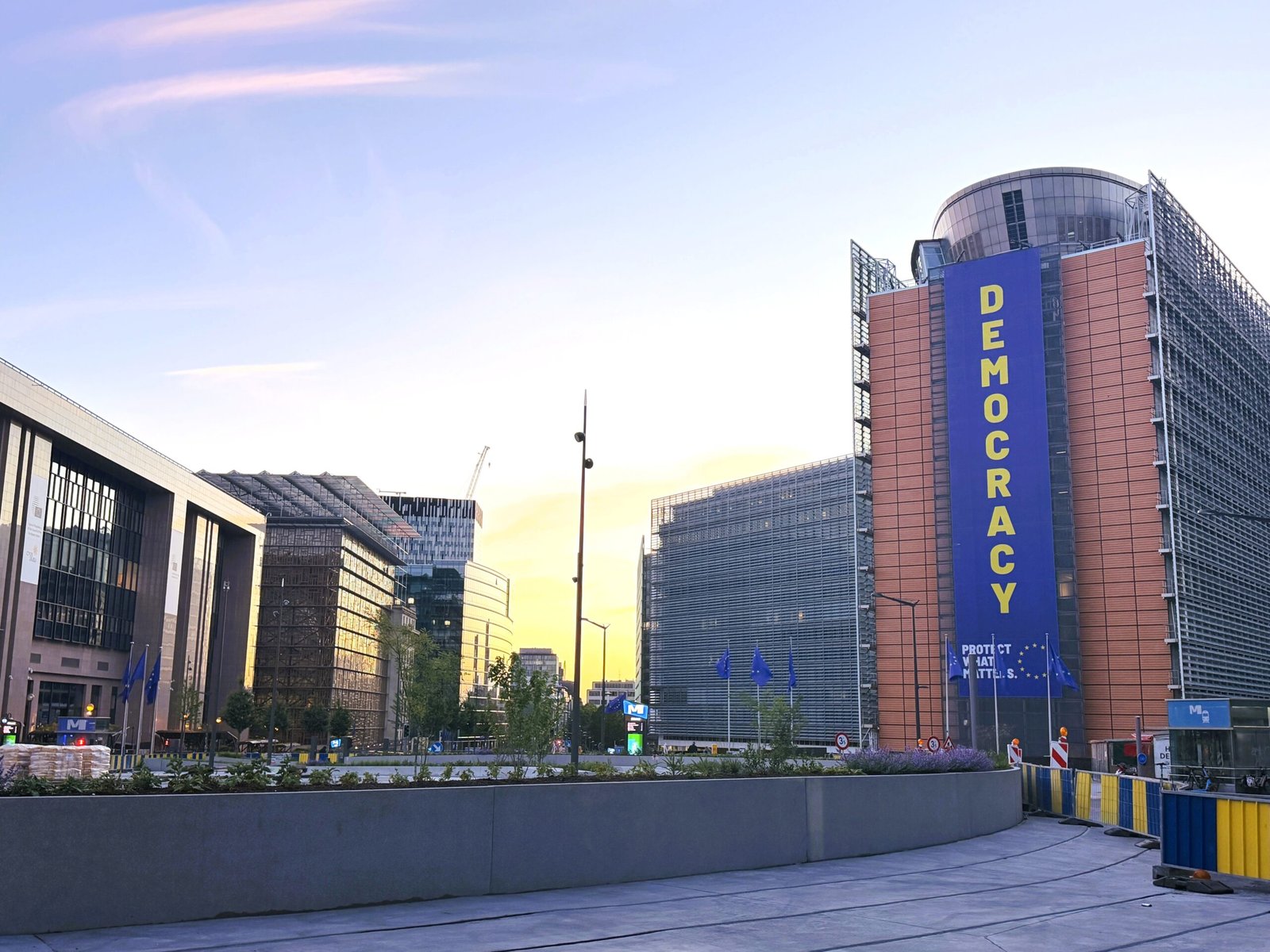
On 14 October 2026, I attended a session on textile collection at the European Week of Regions and Cities in Brussels. Representatives from Catalonia in Spain, Gondomar in Portugal and Prato in Italy discussed what it takes to make separate collection work at local level.
What struck me was how the conversation has moved beyond writing rules. The challenge now is to make those rules work in real towns and industrial regions.
1. Collecting more does not necessarily mean recycling more
EU countries have been required to set up separate collection for used textiles since January 2025. But sorting and reprocessing capacity have not kept pace.
According to figures cited from the European Environment Agency, less than 15% of household textile waste was separately collected in 2022. The rest largely entered mixed waste streams.
As collection grows, operators are facing capacity limits, lower-quality clothing and higher costs for staff, facilities, transport and storage. Fast fashion makes reuse and recycling harder.
Meritxell Budó of the Catalan Association of Municipalities noted that some sorting facilities are already unable to take additional material. Collecting more is not the same as keeping materials in use.
2. Portugal: improving collection and sorting together
Gondomar has collected used clothes and household textiles since 2004, yet still faces challenges with material quality and sorting capacity.
LIPOR, a waste management organisation serving eight municipalities in the Porto area, has been testing automated textile sorting. A pilot facility presented in September 2025 has a planned capacity of roughly 50 tonnes a year and sorts materials into 14 categories by composition and colour.
The work is part of the Be@T project. Alongside sorting technology, municipalities are testing collection methods that may produce cleaner, more usable material, including door-to-door collection.
3. Prato: building on an existing textile industry
Prato in Italy stood out for a different reason. The city has more than a century of experience in recovering and reprocessing textiles. Around 7,000 textile and fashion businesses operate in a city of about 200,000 people.
Sorting, fibre regeneration, spinning, weaving, dyeing and finishing already form part of the local industrial network. Circularity is not a new concept there; it is built into the region’s history.
A new Textile Hub opened in July 2026, with investment of around €31.3 million and planned processing capacity of up to 33,000 tonnes a year. It uses technologies including AI and near-infrared sorting.
The city also wants to act as a “living lab” for new EU textile rules, including ecodesign, digital product passports, extended producer responsibility and end-of-waste criteria. During EURegionsWeek, Prato representatives discussed industry concerns with the European Commission’s DG GROW and DG ENV teams.
That is an important shift: local industry is not only receiving regulation, but helping test whether it works in practice.
4. Catalonia: the cost of collection matters
Catalonia launched a Pact for Circular Fashion in 2022 and approved a new phase in 2026 covering the period to 2030. Partners include public authorities, manufacturers, waste operators, universities and social enterprises.
The region aims, among other goals, to raise separate textile collection to 30% by 2029. Local authorities, however, must pay for collection, transport, sorting, storage and awareness campaigns.
To help bridge the gap before the full extended producer responsibility system is in place, Catalonia increased the tax revenue returned to municipalities for separately collected textiles in 2026—€50 per tonne for typical municipalities and up to €75 in rural areas.
Support is also going into technologies and businesses that can turn recovered fibre back into yarn and products. The policy challenge is not just collection; it is creating demand for the output.
5. Who should pay for products at end of life?
Municipalities have little control over how clothing is designed, what it is made of or how long it lasts. Yet they are left with much of the cost when it becomes waste.
The EU’s revised Waste Framework Directive entered into force in October 2025, introducing common rules for extended producer responsibility (EPR) for textiles and footwear. Member states are required to establish their systems by April 2028.
The aim is not simply to pass collection costs to brands. By taking durability and recyclability into account, EPR can also encourage better product design and longer useful lives.
6. The opportunity for Japan
Japan has strong textile and manufacturing clusters in places such as Fukui, Ishikawa, Aichi and Okayama. But collection, sorting, material recovery, manufacturing and customer demand are not always connected.
Europe’s experience points to the value of regional collaboration. There may also be opportunities to connect Japan’s manufacturing capabilities and process-improvement expertise with European pilots in sorting, traceability and recycled materials.
The starting question should be practical: who will use the recovered material, what product can they make, and will someone buy it at a viable price?
7. What I took away
Textile waste is not just an environmental issue. It touches public services, municipal budgets, technology, industrial jobs and the way products are designed and sold.
More collection is not the end goal. We need systems that keep products in use, industries that can process what cannot be reused, and customers for the resulting materials.
For YEJapan and Circular E, this is a useful area for future collaboration between businesses, municipalities and research organisations in Japan and Europe.
Event details
European Week of Regions and Cities 2026 | Brussels, 12–14 October 2026 | Session attended on 14 October: “Making textile collection work locally: the role of municipalities in Europe’s circular transition.”
Based on the session and published materials. This article includes summaries of speakers’ comments and my own observations.